- Introduction
- The Chantry School
- KM Free Grammar
- Malham
- Malham Girls School
- Scosthrop
- Malham Tarn
- KM United School
- Airton
- Lee Gate & Bordley
Clicking on most pictures will show a larger version
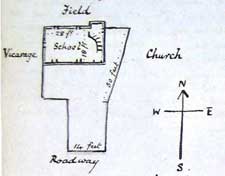
Plan of the school in 1870
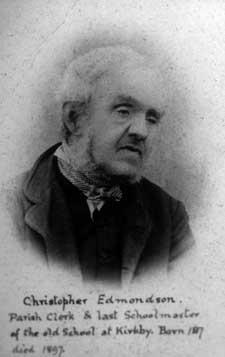
Christopher Edmondson
Christopher Edmondsonwas the last Master of the Kirkby Free School. We know he was born on 14th July 1818, he was appointed on 26th September 1846 and retired in 1872 at the age of 53 once the scheme for the United School was approved and received a retirement pension of £5 5 9d to cover the period up to Dec 1872 and £15 per annum for life subsequently.
Mr J G Fitch’s report in 1869 for the Schools’ Enquiry Commission says that in the past the post of headmaster was occasionally held by the vicar but, other than that, the only indication we have regarding who were the teachers between Timothy Parkinson and Christopher Edmondson, is from the 1841 census return which lists a Rebecca Preston, aged twenty, as a schoolmistress, although we have no independent confirmation that she taught at the Kirkby School. She appears again on the 1851 census married to Christopher Edmondson, then aged 32. She died in 1858 and by the 1871 census Christopher had acquired a new wife and six children.
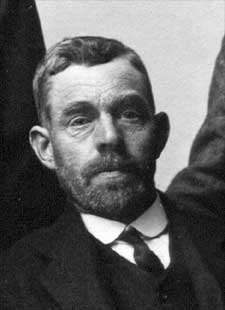
Jim Redfearn
Jim Redfearn who lived all his life on Main Street KM was a pupil
at the school in the late 1860s and early 1870s. He recollected in a 1935
newspaper article that Edmondson ruled in a tyrannical manner but on Sundays
he became a very reverent Parish Clerk. He describes the school thus:
“it was a two-storey building situated on what is now the vicarage lawn, with a playground. The ground floor was used as a Sunday school and the upstairs for weekday school.”
View a list of the Last Students to attend the Free Grammar School in 1873-4.

The History of Education in Malhamdale
Kirkby Malham Free Grammar School (1606-1874)
The Free Grammar School also known as the Old Lambert school in Kirkby Malham, succeeded the Chantry School of the Rood, and was set up in 1606, its purpose being to -
“teach freely all and every scholar who should come to be taught”.
It was in existence for 266 years and only closed when the new school at Kirkby Top superseded it.
It was situated in a building of which little trace remains, to the northwest
of the church and between it and the vicarage. This building was demolished
in 1874. Who owned the building is not known, as no deeds have ever been
found, but the Hearth Tax of 1672 lists it as liable to pay a shilling
tax (on one hearth), and as church buildings were exempt from this tax,
it would appear not have been owned by the Church.
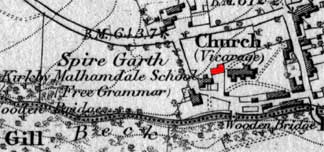
Located between the vicarage and the church
The school was founded by a John Topham, but the original idea was mooted by Benjamin Lambert of Airton (hence the alternative name) whose will (1598), found to be illegal, stated that: -
“All the lands, cottages, rents and inheritances arising of the manor of Kirkby and Hanlith should be used for the salary or stipend of a schoolmaster who is to teach freely every scholar who should come to be taught”.
Henry Nelson of Calton in his will of the same year, bequeathed the lease and income from certain "sheepe gaites" towards the erecting and working of "the free schoole which should besett upp at kirkbie".
This was implemented by John Topham. Further endowments came from an
Isabel Nelson, with £200 in consuls, and £50 from Robert and
James Parker laid out in land (cattle gates) in 1787, which was rented
annually. This land was exchanged for 11 acres on Grisedale in 1849, under
an Inclosure award.
Six trustees were appointed (the owner of Calton Hall always being one),
two from Malham and Malham Moor, two from Kirkby Malham, Hanlith and Calton
and two from Airton, Scosthrop and Otterburn. They were mainly responsible
for the receipt and payment of the income, but it would seem they had
some say in the selection of the teacher, according to some of the letters
they wrote to the Archbishop of York, who had to ratify the appointment
or dismissal of the teacher.
A letter from the trustees to the Archbishop of York dated 1706 reads as follows:
|
We the minister of Kirkby Malhamdale and feoffees of the Free Grammar School there do thus nominate and oblige Stephen Proctor of Kirkby aforesaid who is a man of sober life and conversation to be master of the said Free Grammar School.
|
(Frances Bryer was the Curate and Sir John Middleton married into the Lambert family of Calton).
However a second letter dated 1711 tells a different story. They wrote
again recommending his dismissal because he was:
“…non compos mentis very often and notwithstanding his lucida intervalla (lucid intervals) has for several weeks together wilfully neglected his duties and obstinately scorned authority (when mildly admonished by the feoffees) to the ruins of the petitioners…”
They went on to request that they might appoint Mr Jacobus Northall in
his place.
A list of teachers in the Diocese of York in 1726 shows Jacobus Northall
was appointed by 1712, so obviously their petition was successful. Mr
Northall was still the incumbent after 16 years and in 1775 the baptismal
records name Timothy Parkinson as the Kirkby schoolmaster. He is also
mentioned again in 1776, and is said to be living in Calton when mentioned
in subsequent entries.
Archbishop Herring’s Visitation of 1743 confirms that two public schools were in existence in Malhamdale at that time,
“…one endowed with £20 and the other £10 where about 50 are instructed in the principles of the Christian religion and brought duly to church”
A Parliamentary Paper of 1818 subtitled “A Digest of Parochial
Returns made to the Select Committee to inquire into the Education of
the Poor” describes the school thus:
“ A grammar School at Kirkby, in which 30 children are instructed; the teacher has £21 per annum paid out of different estates originally lord’s rent, left by the Lambert family, and £6 from funds in London, left by one Nelson."
At this time Kirkby Malham had a population of 175, Airton 176, Calton
89 and Hanlith 51, Scosthrop, 80 and Otterburn 47 - the school at Kirkby
probably drew from these villages. A comment followed that
“The poorer classes are desirous of possessing sufficient means of educating their children"
Two schools are mentioned in Malhamdale, the
other being the Grammar school in Malham which had been in existence since
1717.
In 1826 an inquiry by the Charity Commissioners into the charities in Malhamdale, reported on the school as follows:-
“The school is conducted both as a Latin and English School. All boys of parents residing in the parish, who attend to receive a classical education, are instructed as free scholars, and any other children who apply for admission, are instructed in reading, writing and arithmetic, on moderate terms, fixed by the trustees. The number of grammar scholars has been on the decline for some years, owing as it is said, to the little demand in the place for that branch of learning, and at the time of this inquiry, there were only three scholars of that description; but the school is well attended as an English school, the number amounting to between 20 and 30 on an average.”
An anecdote from a publication by William Gomersall called "Hunting in Craven" describes how in the year 1835 when the old Grammar School in Kirkby Malham was undergoing repairs and the scholars were accommodated in the vestry, the hounds from Malham Tarn made their appearance one lunchtime at Cow Close, a large common pasture just above the village, whereupon several of the big boys bunked off to follow the chase. An imposition was put on the truants the next day by the schoolmaster, who was obviously no sport.
In 1846 Christopher Edmondson was appointed Master. In 1869 a report for the Schools Enquiry Commission by Mr J G Fitch, was published. This reported on the state of the school between 1864 and 1867, and disclosed a most unsatisfactory state of affairs. He says :
“The premises are old, and not in good repair. The upper floor which was once used as a dwelling for the master, is now occupied as a schoolroom, and the lower floor, once the school, is now disused. No residence is provided for the master. He receives the income from the endowment, the produce of the children’s fees 2d, 3d or 4d a week and a small stipend as parish clerk and registrar of births and deaths. He has been in his present post 19 years.”
Repairs
and books were supplied by private contribution.
The school was described as a mixed elementary school with 31 boys and
girls, of whom 25 were under 10 years of age being mainly the children
of farmers, farm labourers, and factory hands from the immediate neighbourhood.
Only one boy was learning Latin and he was therefore taught free.
Twenty two children were present on the day the commissioner visited and
he says that they were not well instructed even in the simplest rudiments,
of which only reading, writing and arithmetic were aimed at. The trustees
were only concerned with the finances of the school and there was no one
to concern themselves about the school or to see that it was run efficiently
as they had no control over the instruction. The report ends by saying
that it was regretted that the effect of the endowment was simply to maintain
a poor and neglected school and to discourage the establishment of one
suited to the requirements of its inhabitants. As a result of this poor
report, when the Endowed Schools Commission was set up, Walter Morrison
wrote in 1879 to the Commissioners giving statistics of the schools in the Dale,
and suggested that their funds might be amalgamated.
When in the following year the Commission considered the Malhamdale Schools the following valuation of the school was produced on June 30th 1870.
Valuation of the School and Playground and Convenience attached at Kirkby Malham |
|
The School is a two story building and each room has a fireplace and measures 7¾ yards by 6 yds. The upper room is reached by staircase 6 yds by 6 ft 6 inches under which there is storage for coal. £7 per year at 22 years purchase |
£154. 0. 0 |
The playground enclosed and contains an area of about 200 sq yds 8/- per year at 30 years purchase |
£12. 0. 0 |
The position of the school is a good site between the Parsonage and the Parish Church. |
|
Total Balance |
£166. 0. 0 |
Mr Edmondson also provided unaudited accounts for the school for the year to December 31st 1869.
| School Pence | £11.10. 7 |
| Quit Rents | £10. 9. 3 |
| Rent of School allotment | £11. 0. 0 |
| Interest on Consols | £6. 0. 0 |
| Rent of School garden | 2. 6 |
| Rent of Sunday School | 2. 6 |
Total |
£39. 4. 10 |
All this is received and appropriated by the Master. The above named School allotment is on the NW side of the Malham School allotment. It consists of 11 acres on Grisedale, east by north of Kirkby Fell. (verified by reference to certified plans of the Commissioners in vestry of Parish Church) It is let to Mr Obadiah Coates of Malham, yearly, at above named rent, which is revised yearly. The above named School Garden is just east of Kirkby Bridge and appeared to me to be about 51 x 12 feet. It is let yearly by the Master.
The amalgamation
was finally approved in 1872 and led to the foundation of the new United School
at Kirkby Top. The old building was pulled down in 1874, the year in which the new school
at Kirkby Top opened.